
Leadership is the business of shaping identity
Summary
Leadership isn’t only about driving business results. It’s also about shaping group identities that people thrive in and wish to belong to. Crafting strong identities takes both inclusivity and distinctiveness. When we belong, we feel more psychologically safe and are more open to being constructive dissenters in our teams.
This blog post summarises some ideas I’ve gathered from the work of Jay J. Van Bavel, Dominic J. Packer, Amy Edmondson, Daniel Coyle and Charlan Nemeth. The synthesis is original, but the underlying content isn’t.
Jesse Owens is an Olympic icon. In the 1936 Berlin Olympics, Owens won four gold medals at the height of racial prejudice in Nazi Germany. You can imagine how much it annoyed Hitler and co. But do you know about the shoes Jesse wore? Well, that’s a whole other story.
Those shoes came from the Dassler Brothers Shoe Factory, run by, you guessed it, two brothers — Adi and Rudi. Owens’ victory pitchforked the brothers into shoemaking fame, and you’d think that success would have strengthened their brotherly love.
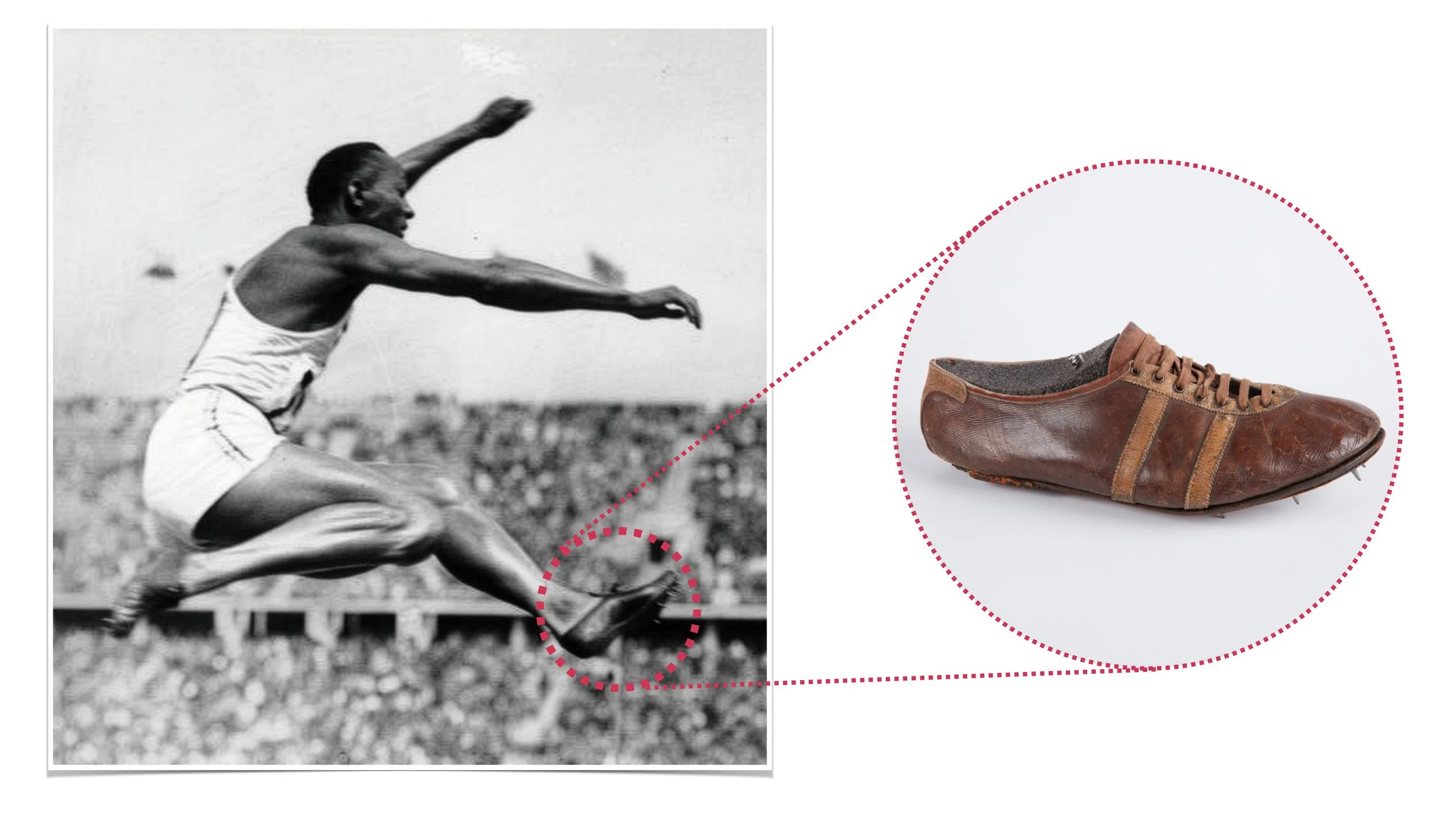
Jesse Owens wearing the distinctive Dassler shoe. Photo credits: Bundesarchiv and Olympic Museum
But soon after the war, Adi and Rudi went on their own warpath. They wouldn’t talk to each other. They each took one side of the river in their town, and the town found itself divided. You were either part of the Adi camp or the Rudi camp. If you were from the other side of the river, you couldn’t buy food from this side of the river or get a table at a restaurant. You couldn’t date or marry into the other side. When you walked around town, you’d look down at the shoes people were wearing and decide if they were your people or the others. It was literally “the town of bent necks.” The rivalry was so fierce that when the brothers died in 1974 and 78, their families buried them at opposite ends of the town cemetery.
By the way, if you haven’t guessed yet. The two companies were Adidas, founded by Adi Dassler, and Puma, founded by Rudolf Dassler.
One town. Divided. Brothers, but rivals. In-groups versus out-groups. Us versus them. That’s the dynamic we’re talking about. And if you think of the root cause, it’s possibly down to mere misunderstanding. Look, the Dassler brothers were Nazis. History documents their loyalties well. Apparently, one day in 1943, when the Allies were bombing Germany, Adi and his wife got into the same bomb shelter as Rudi and his family. Legend has it that Adi said, “The dirty bastards are here again.” Adi may have meant it about the warplanes, but Rudi took it as an insult to his family. I’ve already told you how the rest of the story unfolded.
That said, there was a truce after all. In 2009, three decades after Adi’s death, the two companies played a friendly football match to bury their differences. Ah, sport! Something for us to come back to, in a few minutes.
But first, us versus them.
What drives these divisions? It could be something as small as a misunderstanding. There are many such fractures within corporations. The most classic fracture is that between employees and management. If such fractures are the antithesis, then a cohesive group identity is the thesis, isn’t it? Allow me to explain. Look, each of us assumes several identities, much like shape-shifting chameleons.
When I wear my favourite cricket team’s jersey, I’ve assumed the identity of an RCB fan. If I’m in a stadium with people wearing the same shirt, it doesn’t matter what their other persuasions are. We’re all the same. We share heroes, symbols, songs and slogans. We’re rooting for the same team.
When I’m in the forest looking for wildlife, other photographers and naturalists are part of my in-group. We all want the same thing — epic wildlife sightings! So, we help each other. I may not know the other person from Adam, but who cares — we are different, but the same.
The stadium and the forest are what you could call containers of trust. While I’m in there, sharing an identity with others, I trust the other person like me. When we leave that container, other identities take over, and, be it politics, religion, or parenting styles, the us-and-them dynamics change. Leadership, at any level, is about shaping these containers of trust — who belongs, what we stand for, and how we deal with fractures when they emerge.
So what drives that powerful sense of identity?
To explore that idea, I want to contrast two advertisements. The first one is a 2020 spot from Scandinavian Airlines.
Scandinavian Airlines argued that NOTHING; yes, NOTHING; is truly Scandinavian. The Nordic people borrow an eclectic mix of food, culture, politics, and traditions from other places on their travels. So Scandinavian Airlines encouraged its customers to bring other wonderful things “piece by piece” into their inclusive culture. Great message, huh? Not quite.
Scandinavian faced a huge backlash for their ad, albeit from a certain end of the political spectrum, and they eventually pulled it. Thankfully, the internet hasn’t forgotten, and we still have access to the video.
The contrasting ad is from Molson’s Brewery. In the year 2000, they ran this spot.
Jeff Douglas played the average Joe Canadian, ranting with pride in everything that was distinctively Canadian. Guess what? The commercial won the Gold Quill advertising industry award in 2001. And it was so popular that, when Trump took aim at Canada in 2025, Jeff returned to reinforce pride in Canada's distinctive identity. It’s a must-watch video!
Now look, Canada has a lot in common with Scandinavia or, for that matter, the United States. So yes, diversity and inclusion seem very Canadian. But strong identities emerge not only from belonging; we also need distinctiveness.
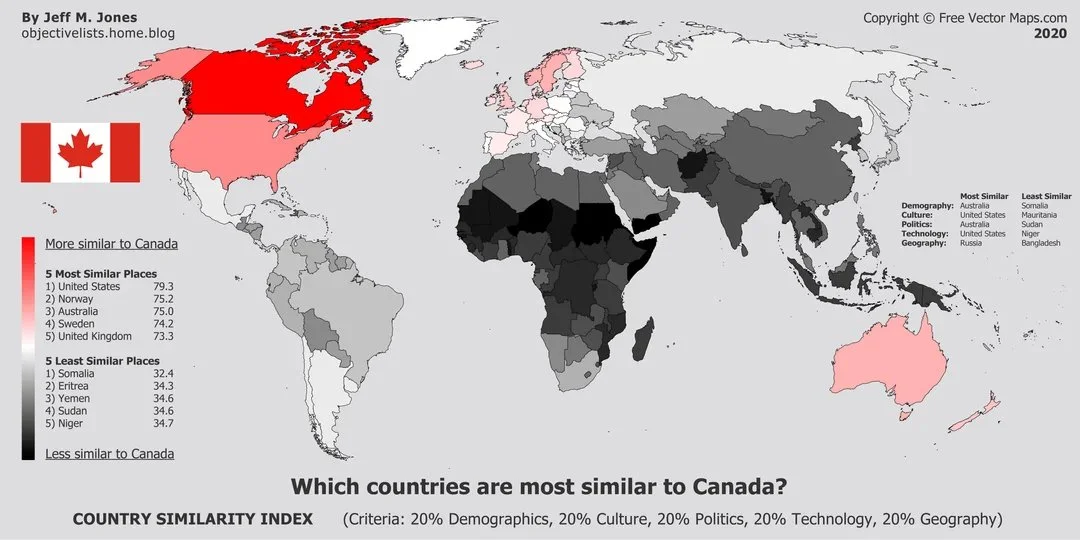
Canada is similar to many countries, but it also has its distinctive characteristics (source)
As a cultural architect, I think of this challenge all the time. How do we craft a cultural identity that is attractive to diverse people while also being unique? Too much focus on inclusion, if there’s even such a thing, can lead to an identity that feels rather bland. Overdo distinctiveness and you go right back to the us-versus-them fractures from that little German town. “Optimal distinctiveness” is key, and indeed this is where leaders play a part at all levels of an organisation.
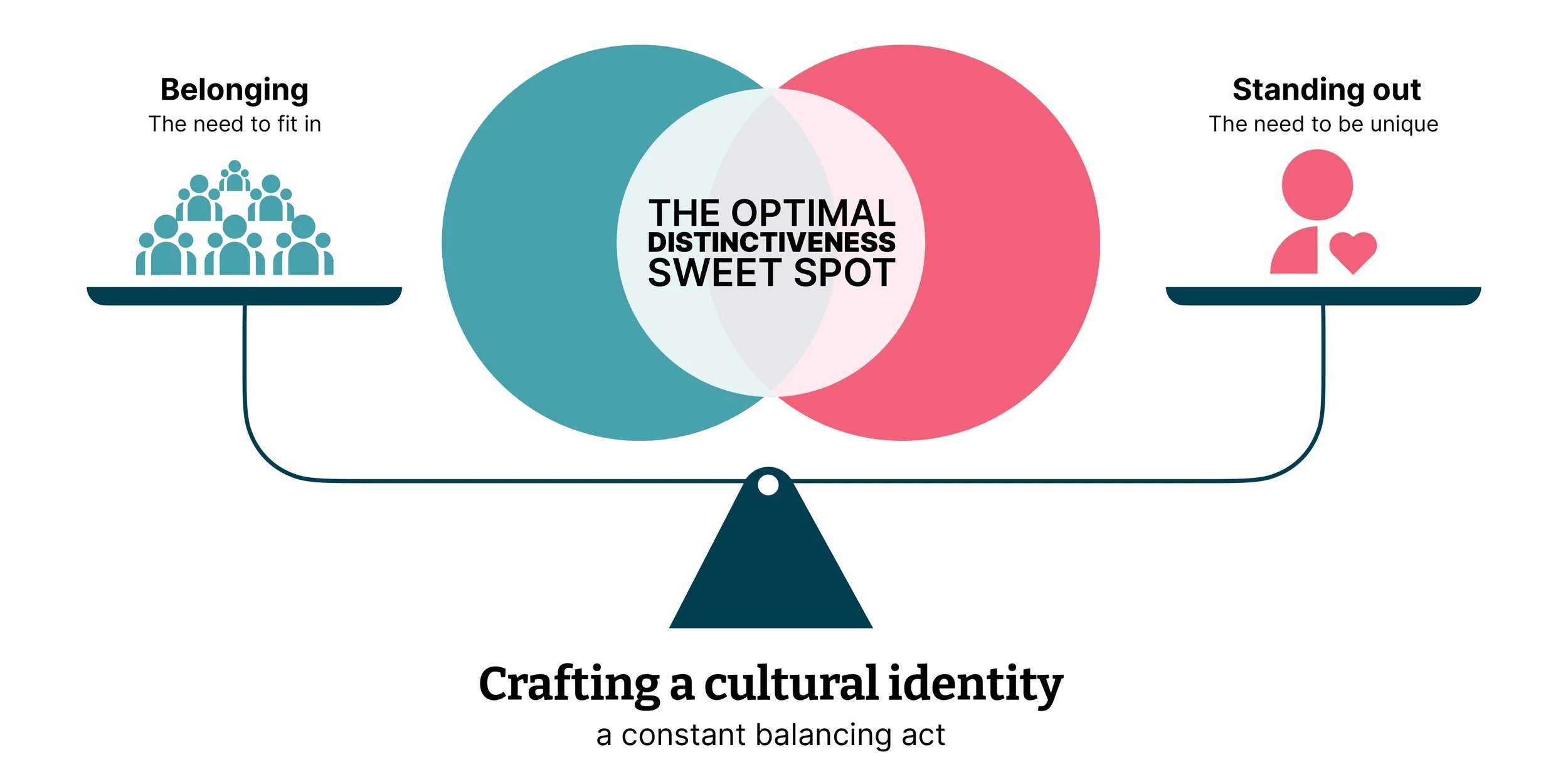
Strong cultural identities balance belonging and distinctiveness
The role of the identity leader
The beauty of the human experience is our ability to construct myths. Harari explains this concept in the book Sapiens.
“Large numbers of strangers can cooperate successfully by believing in common myths. Any large-scale human cooperation — whether a modern state, a mediaeval church, an ancient city or an archaic tribe — is rooted in common myths that exist only in people’s collective imagination.” - Yuval Noah Harari.
The idea that a piece of paper we call a dollar bill has inherent value is a myth. Try explaining that to a monkey or a lion. That generously sharing your bananas with a hungry human being could get you time in heaven is a human myth. Monkeys don’t believe in monkey heaven. Similarly, you can’t touch or feel a corporation. That’s a myth. The only real, tangible, touch-and-feel interface between a corporation and its people comes from its leadership. The management is the corporation.
Shaping identity and healing fractures
I promised to return to sport, so here’s my next story. It’s immortalised in the movie Invictus, in which Morgan Freeman plays Nelson Mandela. You know Mandela spent three decades in prison, under the apartheid regime, which ended in 1993. Mandela became president in 1994, and after years of sanctions, South Africa was to host the 1995 Rugby World Cup.
Today, Siya Kolisi, a black man, is the two-time World Cup-winning captain of the South African rugby team, the Springboks. But back in the apartheid days, rugby was mostly a white man’s sport, and so the blacks hated it with a passion. During his incarceration, Mandela, too, cheered every team that played against the Springboks, if only to annoy the jail wardens. In fact, there was even a motion to get rid of the green and gold of the team uniform and to replace the Springboks emblem with the Proteas flower. After all, most blacks saw these as symbols of oppression. But Madiba saw them as a way to forge a group identity. The green and gold stayed. Not a popular decision. So did the Springbok. One team. One country. One tournament to win.
In partnership with Francois Pienaar, then captain of the Springboks, Mandela ran a nationwide campaign to take the players and rugby to the masses. On the day of the final, Mandela walked into the South African dressing room, not just as a president, but also as a rugby fan. He wore the Springbok cap and jersey. Francois Pienaar choked up when Mandela shook his hands and turned around. Mandela was wearing number 6 on his back — Pienaar’s number. South Africa won that World Cup. Of course they did!
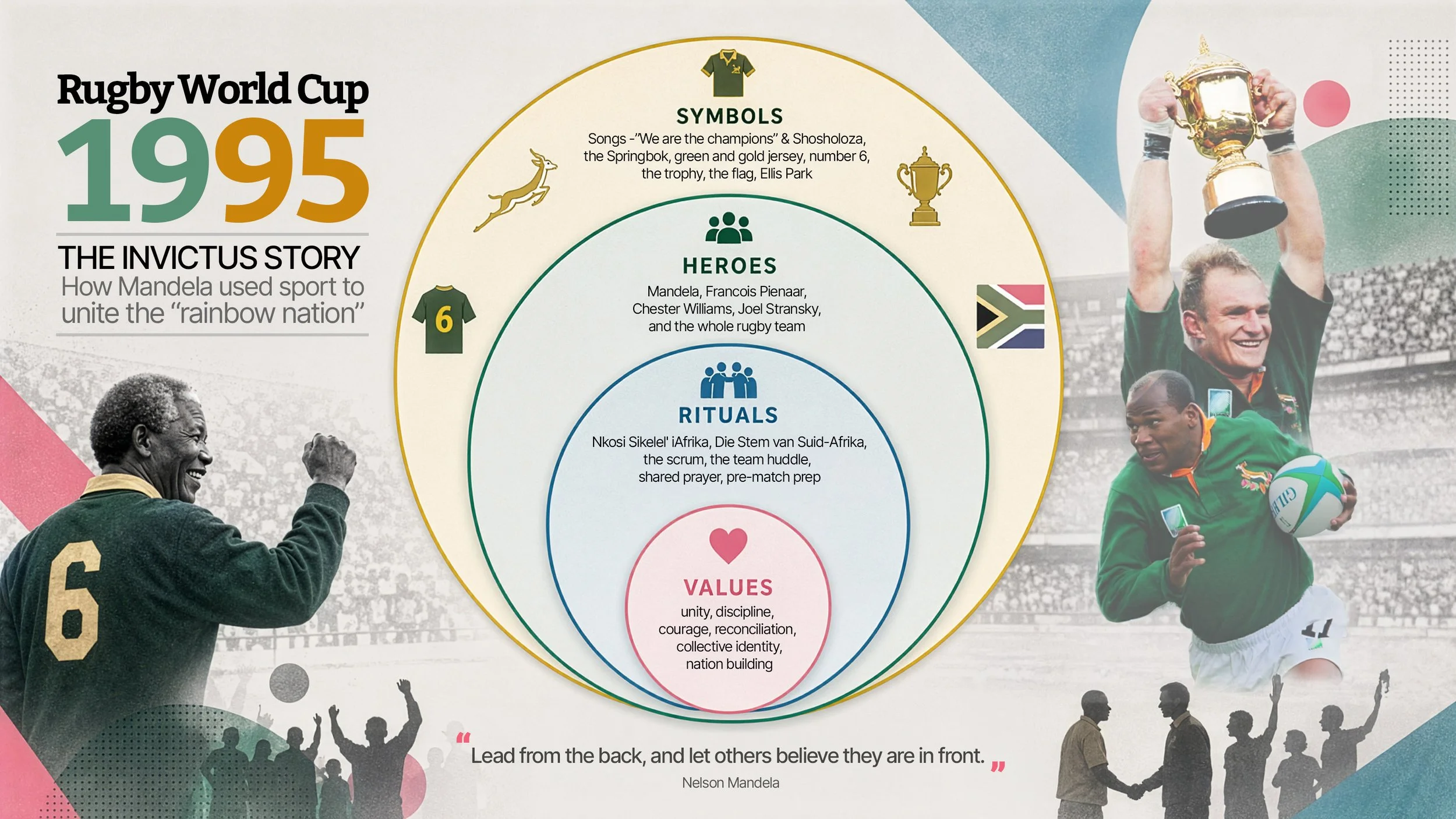
Mandela used rugby to bring citizens of his "rainbow nation" together
It’s easy to dismiss Mandela’s actions as PR or symbolism. They were amongst many steps toward the “rainbow nation” he dreamed of. For example, South African leaders didn’t bury the past under a rugby jersey. They established mechanisms like the Truth and Reconciliation Commission to grapple with the nation’s horrific history of apartheid and thus help to secure a more hopeful future. 30-odd years since apartheid ended, South Africa is still one of the most unequal nations out there. Still, there’s no denying how Mandela cultivated a shared ethos amongst the citizens of the rainbow nation.
Nurturing shared pathos and ethos through prototypical leadership
Leaders don’t always represent the average group member. Aiming for “typicality” is a trap. Instead, the goal should be to aim for “prototypicality,” i.e. leaders who capture the essence of who the group members think they are or want to be. Mandela was a great example. Ex-Navy SEAL Team Six commander Dave Cooper is another example. I read about his story in Dan Coyle’s book, “The Culture Code”.
Cooper started his journey to being a prototypical leader — someone his operators deeply respected and simply referred to as "the dude" — during a disastrous mission in Afghanistan on New Year's Eve 2001. On that day, Cooper unthinkingly followed a superior’s flawed plan, which led his team into a terrifying ambush, forcing them to surrender and wait for rescue. In Dave Cooper’s world, submitting to such “authority bias” can lead to life-or-death consequences.
Ever since that fateful night, Dave has refined his leadership style by inviting his team to poke holes in his plans and championing after-action reviews (AARs). AARs are rank-free, truth-telling sessions. The idea is to talk about what went wrong, and Cooper says that “I screwed that up” is often among the most important words a leader can say. Why’s it important to seed this vulnerability loop?
Well, first, that vulnerability builds a profound shared pathos — an emotional interconnectedness in which team members set aside their natural self-protection and bond tightly because they realise they need one another to survive.
Second, the team establishes a powerful shared ethos — what Cooper calls a “backbone of humility”. Being right is less important than seeing and seeking the truth, and taking ownership of mistakes, regardless of rank.
Finally, it helps the team realise that the only way to be invulnerable is by being vulnerable together.
Cooper’s backbone of humility and prototypical leadership cuts across both real-world operations and drills. In the real world, the team can call him out if they see him making a tactical mistake. In drills, the team can simulate the most dangerous, often disastrous scenarios and react by self-organising without the pressure of rank. They can then reflect on every mistake in an AAR to fine-tune how they’ll react in real-world situations. By the way, agile retrospectives are the tech industry’s take on AARs.
Over time, the vulnerable practice of AARs makes identity concrete. In Cooper’s world, the team isn’t just a bunch of “elite operators”. They’re people who tell the truth, own their mistakes, and survive together. Their truth-telling ritual solidifies their identity.
In several professions, we earn top dollar for knowing the right answers. That training almost sets up leaders to appear invulnerable to their teams. Such a facade of invulnerability can be pernicious. On one hand, it promotes “authority bias”, where people assume the leader must be right. On the other hand, it creates an invulnerability cascade in which everyone pretends to be invulnerable. Truth-telling becomes the casualty. Psychological safety and dissent are the other casualties.
Cultivating group identities that foster psychological safety
Everyone recognises the importance of debate and dissent, and yet, it’s challenging to be a dissenter. Most dissenters are up against a group norm. That group norm could result from status quo bias, groupthink, following an authority figure's lead, or inertia. There’s, of course, inertia of rest, where people don’t see a reason to deviate from the norm. But there’s also inertia of motion, driven by deadlines and work pressures. In such situations, groups can implicitly or explicitly label a dissenter as “idealistic”, “self-righteous”, “impractical”, “lacking context”, and whatnot.
But as Professor Charlan Nemeth notes in her book, “In Defense of Troublemakers”, dissent is not the end-all. You may eventually not follow the dissenter’s suggestions, but being open to dissent can lead to divergent thinking.
“Good decision-making, at its heart, is divergent thinking. When we think divergently, we think in multiple directions, seek information and consider facts on all sides of the issue, and think about the cons as well as the pros. Bad decision-making is the reverse. Thinking convergently, we focus more narrowly, usually in one direction. We seek information and consider facts that support an initial preference. We tend not to consider the cons of the position, nor do we look at alternative ways of interpreting the facts.” - Charlan Nemeth.
Before we get into a leader’s role in fostering constructive dissent, let’s first unpack the choices people make before expressing a dissenting view.
First, they examine the status quo and ask if they disagree with the norm. Most people don’t speak up unless they have a principled disagreement.
Second, they ask how much of a stake they have in the group’s success. The more one identifies with the group, the higher the stakes. Staying silent is seldom an option if one’s invested in the group identity.
Third, people examine the costs of speaking up. If they expect the social or existential costs to be high, they stay silent. If the costs are low, they speak up.
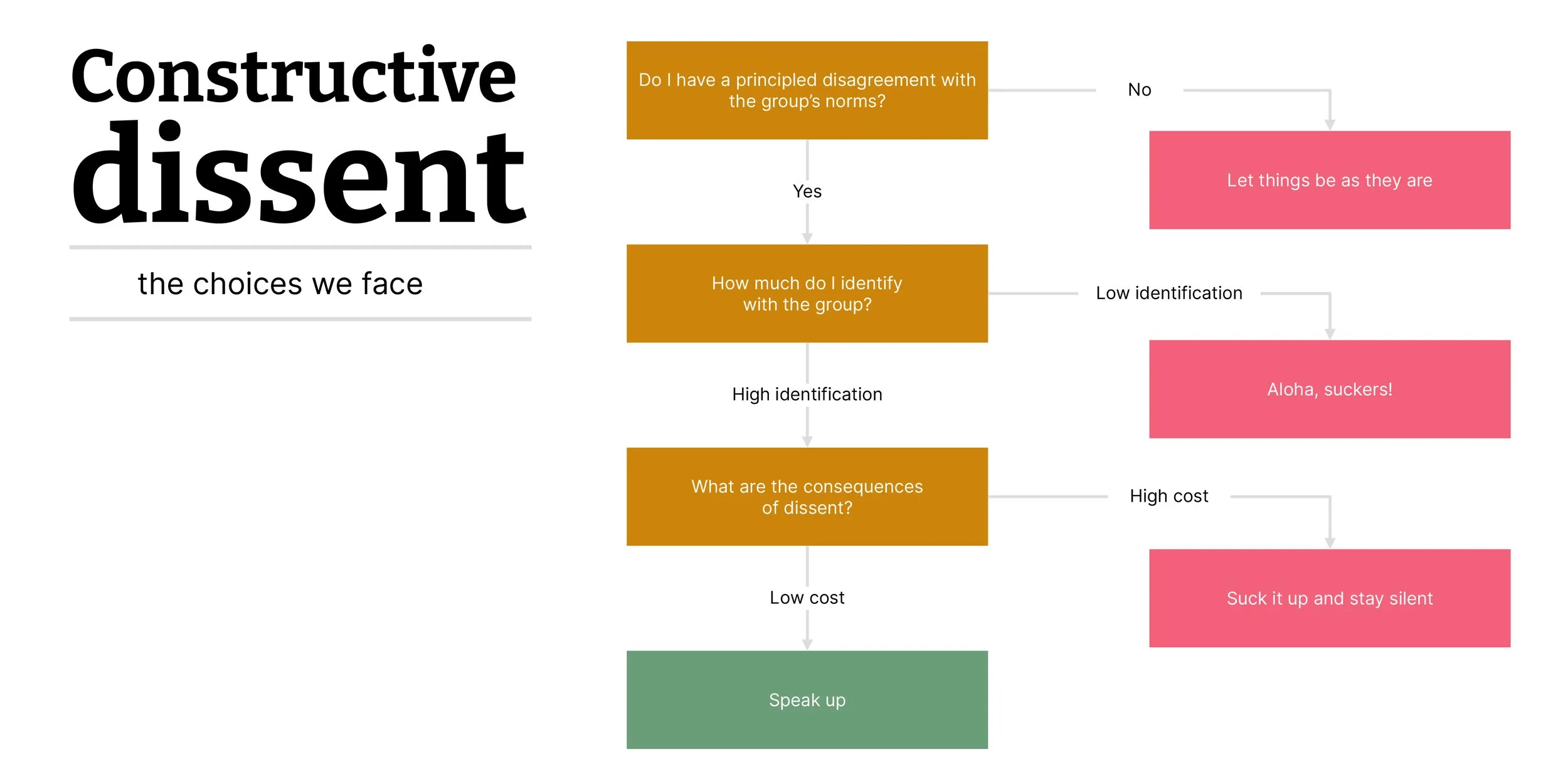
The choices we make before expressing dissent
For the first fork of this decision tree, you can hire high-integrity, critical thinkers into your team. People who are open to new experiences are also naturally divergent thinkers and are likely to speak up.
For the third fork, you can reduce the costs of speaking up by employing a variety of techniques.
At an organisational level, you can reinforce a no-retaliation policy to protect dissenters and establish channels for reporting retaliation.
At the team level, you, as a leader, can practice vulnerability and embrace practices such as retrospectives and after-action reviews.
More broadly, you can encourage a see-something-say-something mindset, counterbalanced by a disagree-and-commit mindset, fostering a spirit of constructive debate.
But the second fork — helping people feel part of the group — that’s all about crafting a group identity. It’s about belonging and distinctiveness. It’s about values, rituals, heroes and symbols. It’s about creating that container of trust. And remember, our group identities are fluid. Even in a corporation, we shape-shift across multiple group identities.
Leaders shape identities at multiple levels
It’s easy to think that the only culture and identity that exist in a company are those espoused in its brochure and employer brand. Of course, that identity is important. And the onus of cultivating that identity falls squarely on the most senior leaders in the company, starting with the C-suite.
That said, there are other identities leaders can’t neglect. In a large company, different regions will shape their unique identities. The culture of that geography influences the subculture of the company’s regional offices. Within a company, there are often affinity groups, communities of interest, and communities of practice. Each of these communities will have its own notions of belonging and distinctiveness. They’ll have their values, rituals, heroes and symbols.
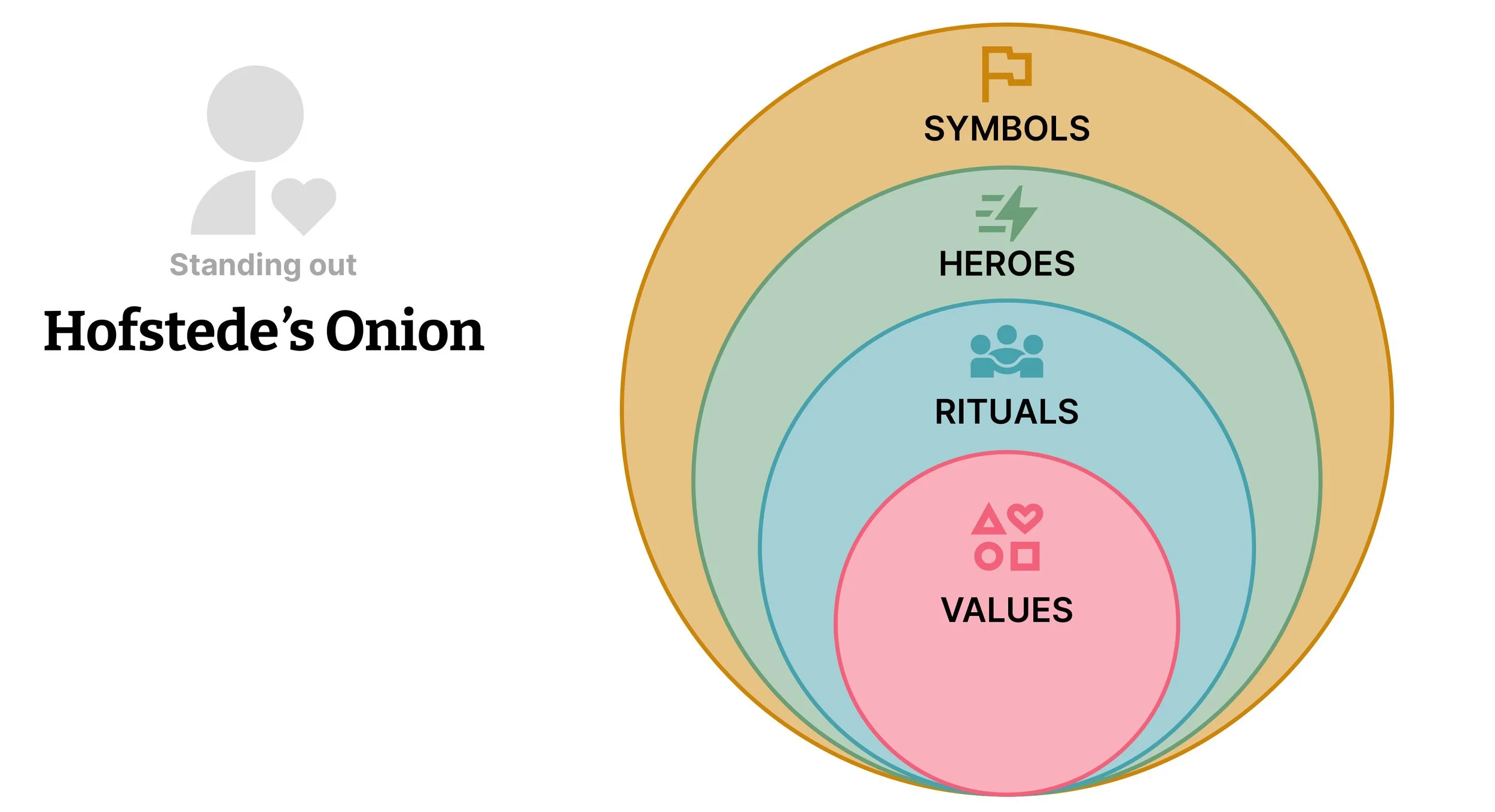
Hofstede’s onion provides a framework to shape distinctive cultural identities
But most importantly, at the grassroots level, every function, every department, every team will have its own group identity, whether by accident or by design. Team leaders are responsible for shaping, nurturing and protecting these identities.
So here's the thing. Whether you're leading a team of five or a company of five thousand, you're in the identity business. You're not just managing tasks or hitting quarterly targets. You're shaping the myths people believe in, the containers of trust they operate within, and the us-versus-them dynamics that either divide or unite them.
The Dassler brothers divided a town over a misunderstanding. Mandela united a nation through sporting heroes, symbolism, truth and reconciliation. Dave Cooper created invulnerability through vulnerability. These aren't just inspiring stories — they're blueprints. The question isn't whether you'll shape identity; it's whether you'll be intentional about it. And if there's one thing I hope you take away, it's this: the work of crafting belonging and distinctiveness, of fostering psychological safety and constructive dissent, of being prototypically you — that's not separate from your actual work. That is the work.