
Being militantly human
Summary
AI-generated content is often devoid of character and authenticity. By delegating content generation and communication to LLMs, you’re signalling a lack of care, conviction and connection to your audience and consumers. To stand out in a crowd of AI-slop, consider being militantly human.
Recently, Google surprised me by announcing some new features that could be useful, for a change. They upgraded Google Vids, to record talking-head screencasts. Asynchronous, short-shelf-life video is one way to reduce avoidable meetings. They may have upended the market for Zoom Clips and Loom, though, as usual, Google’s product addresses basic needs but lacks sophistication. I welcome the update, though.
I’m not a fan of their AI avatars and AI-generated voices, though. Sure, there’s a place for these things. If I wanted to create some throwaway content, I’d probably use these features. For higher stakes, though, I wouldn’t touch them with a bargepole. Not a chance. The more AI makes it effortless to appear on screen without actually showing up, the more important it becomes to insist on our messy, imperfect, human presence.
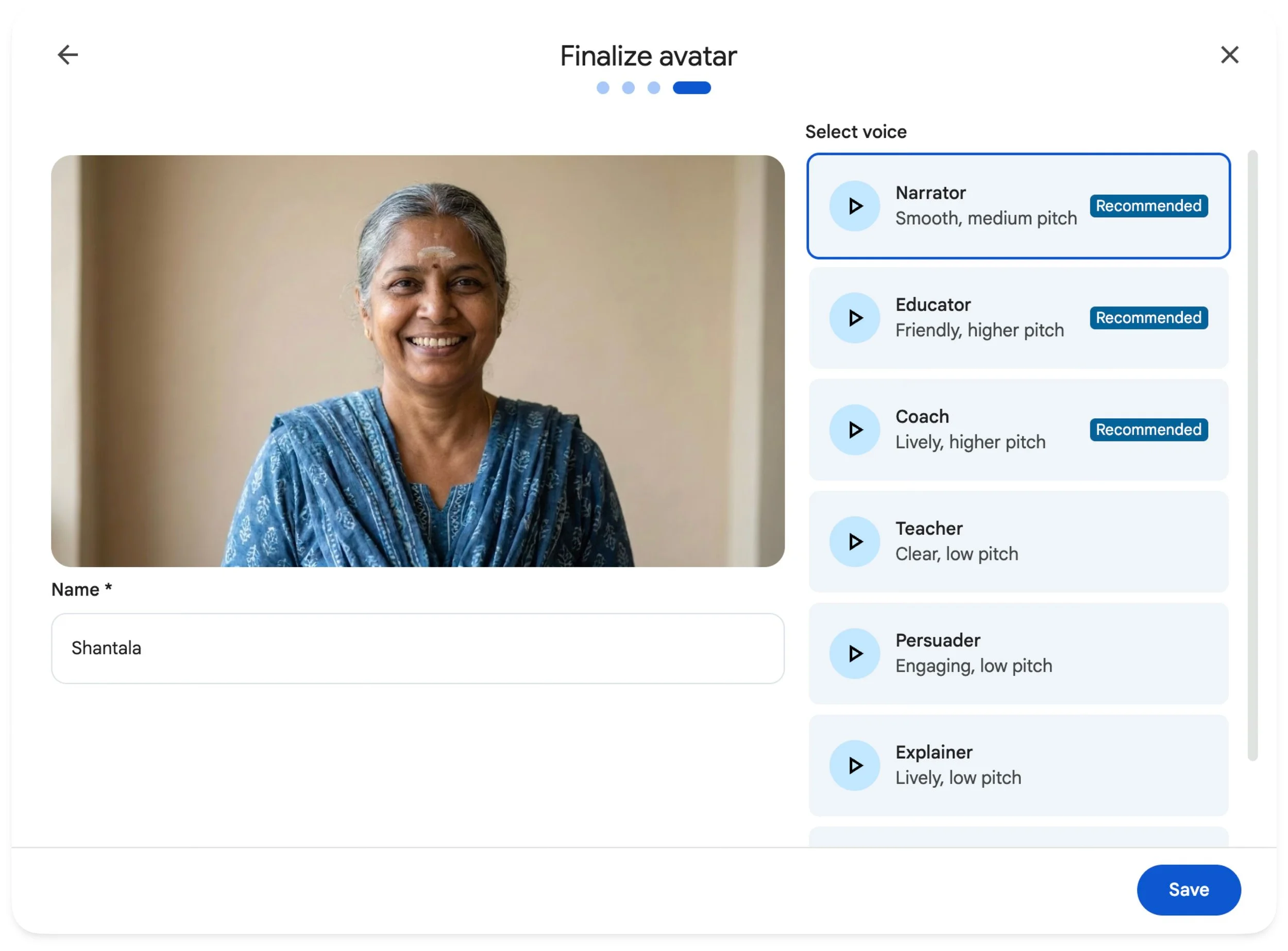
Now, you may ask why I’m being such an uppity snob. Well, as I’ve said earlier, AI looks like AI, writes like AI and sounds like AI. AI audio sounds a bit too perfect and devoid of texture, accents and other idiosyncrasies, for my liking. And while synthetic media generation is improving, matching AI-generated video to realistic-sounding voices is harder than creating the output from scratch. In the example below, notice that while I can create a realistic-looking avatar of a middle-aged, tradition-bound Indian woman, I can’t quite give her a matching voice.
Generating authentic, AI-generated content is still hard
But I have an even more fundamental question. If AI-generated media is so awesome, why is Google still hiring human actors for its Gemini ad campaigns in India? Surely Ravi Shastri, Farah Khan, Jemimah Rodrigues, Vaibhav Suryavanshi, Shubhman Gill, Ishan Khatter and Sara Arjun as brand ambassadors don’t come cheap? Is Google telling us that there’s still a place for being militantly human?
I understand that it's seductive to outsource thinking to an LLM, especially when an egg-headed rich man tells you that introspection is overrated. Of course, thinking is so overrated that we don’t stop to think whether we’d take the same advice from a random person on the street. Or even from our close friends. But yeah, when a rich beneficiary of the Silicon Valley boys’ club makes a pronouncement, we perk up and listen.
Anyway, I digress. Even if thinking seems laborious, and it feels easy in the short term to delegate creative labour to LLMs, consider the fallout.
What does it say about your message if you don’t even care about appearing on camera to support it?
How confident should people feel about your ideas if you won’t even lend them your voice?
What should people feel about your story when you use slides that look obviously AI-generated?
How authentic does it feel to watch or listen to a character with a uniform rate of speech, with perfect pronunciation, that doesn’t need a single jump cut?
The moment you produce the one-click-and-you-are-done kind of AI-generated content, you’re telling your consumers that you don’t care enough. That the message, the story and your relationship with your audience aren’t important enough for you to invest creative labour. You lose all pretence of authenticity, the moment you make an AI avatar your proxy and the moment people see a profusion of em dashes in your writing.
Many of us are nervous about being on camera. That discomfort is human, and when we show up with it, our viewers connect with our authenticity. Not everyone is a trained voice artist. So, when we fluff up our lines, intonate incorrectly, or bring in our imperfect, inconsistent pronunciation, we connect with the imperfection within each of our viewers. When our slides look different from the stock-standard, death-by-PowerPoint fare, people stop to pay attention. Our writing is a vehicle for our thoughts and our ideological and intellectual stances. We don’t probabilistically fit words after one another as an LLM does. Still, we engage in a cognitive struggle to produce outputs we feel emotionally or intellectually connected to.
It’s our idiosyncratic style that makes us stand out in a crowd. Sometimes the world doesn’t care for those idiosyncrasies. The message or the output isn’t important enough. But quite often, the delivery matters as much as the output. That’s when raw authenticity beats AI polish. That’s when stories shine, faces connect, and voices reverberate. Indeed, those are the times to be militantly human, even when it’s easier to summon the stochastic parrots.
PS: It’s possible to create high-quality content with AI! I’m not disputing that at all. But if you’re looking for low-effort, zero-thought, and high-impact, then I’m sorry. You’ll be disappointed more often than not. To invoke the lovable Ted Lasso,
“Taking on a challenge Creating content is a lot like riding a horse. If you’re comfortable while you’re doing it, you’re probably doing it wrong.”