Summary
While death by PowerPoint has been a much-talked-about phenomenon for decades, collaborative slideware and AI have elevated slideuments, Frankendecks and the resulting poor presentations to epidemic proportions. I’m starting a new writing project to address these problems of the workplace and provide readers with simple, actionable advice to elevate the way they tell visual stories and convey information to their colleagues.
A few years back, I was leading an engineering transformation for one of Thoughtworks’ clients. You know the familiar trope about consultants — our deliverable is often a presentation. Thoughtworks consultants, of course, do far more work than that, but as the engagement lead, I had to present the results of our work to our client sponsor.
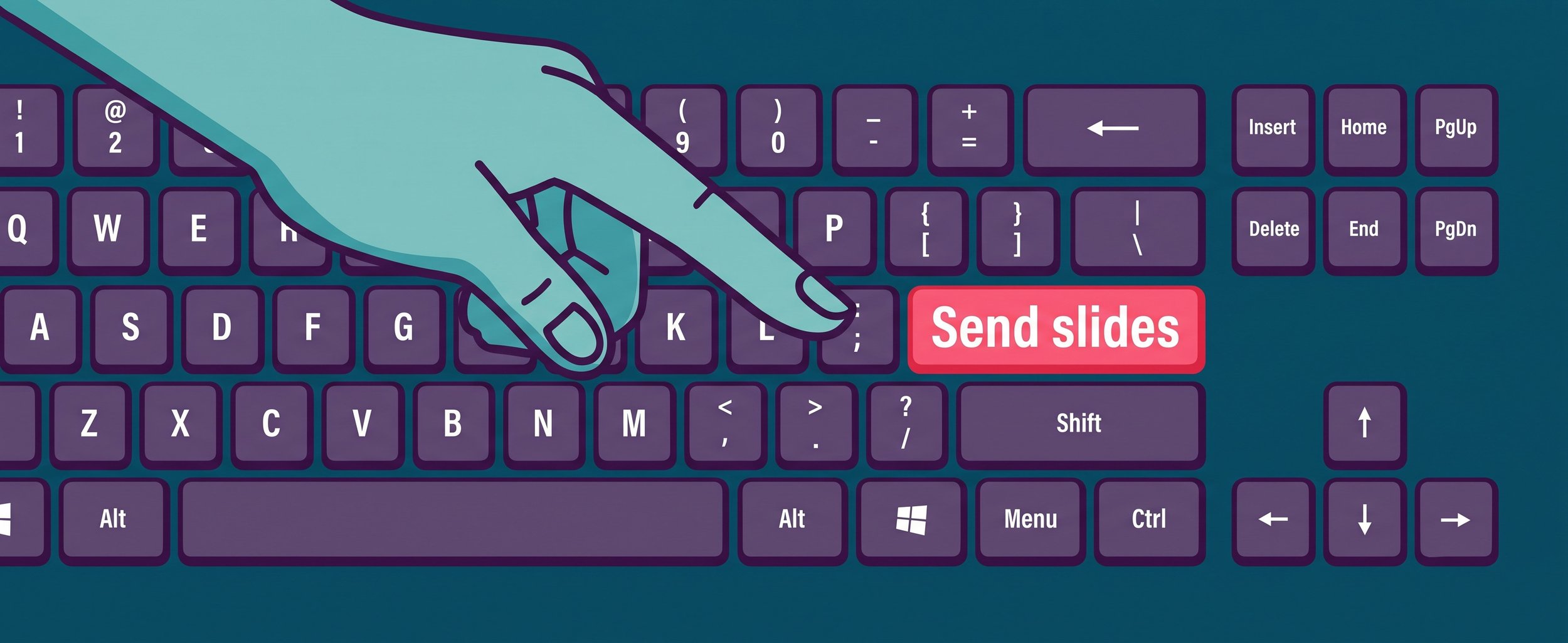
So, we pieced together an impressive story and an impactful set of visuals to support our narrative. The meeting was the day after, so my co-lead asked me to “send the slides” to our client so they could “pre-read” the content. I refused. I refused because our slides weren’t readable. Much of the content would come from the spoken word. Without the presenter, there would be no presentation. We didn’t send the slides. At the time, my colleagues may have been unconvinced by my reasoning.
To cut a long story short, the presentation went even better than I’d expected. Our decision to hold back the slide deck allowed us to introduce information in sync with our narrative. We could orchestrate the emotions in the room and retain a sense of intrigue. We could hold back data for the moment that it’d have the most impact. The client was thrilled with what we’d achieved, mostly because we’d done a great job, but partly because we told our story in an impactful way.
The story of that presentation went viral at Thoughtworks for a short while. I remember presenting different versions to leadership and transformation groups, and even writing up learnings so that others could replicate our success. And then, we went back to the status quo of sending slides as pre-reads. I couldn’t change a thing at my company. To this day, though, I never send the slides. Never in advance, for sure.
Slides for presenting; documents for reading
“Slides are slides. Documents are documents. They aren't the same thing. Attempts to merge them result in what I call the "slideument" (slide + document = slideument).” - Garr Reynolds
The practice of “sending slides” has its roots in the practice of creating slideuments. Knowledge workers are always short on time. Slides are already a ubiquitous artefact in boardrooms and Zoom meetings. So, why not create one artefact that you can present, and your audience can read?
While I empathise with the lack of time and understand the intent behind creating slideuments, these artefacts are neither good presentations nor good documents. Research on computer-based training from as far back as 1998 and 2004 shows that reading while we listen hurts our comprehension. Any good document needs complete sentences, perhaps paragraphs, subheadings, and bullets. By definition, such an artefact can’t be an effective visual aid for presentations.
Moreover, slides don’t lend themselves to good writing.
First, these tools don’t always come with modern writing aids, such as spelling, grammar and style checkers. For inexperienced writers, this is a bit like driving a stick shift, when you’re better off with a forgiving automatic.
Second, it’s not productive to fit the form-factor of slides. How do you squeeze your writing onto one slide? How do you slice information between slides? How do you lay out elements on a slide, in a visually appealing manner? All these decisions add to the cognitive load of writing, which in itself is a thinking process. Whether it’s the more modern 12:5 ratio or the 16:9 HD ratio or the old school 3:2 or 4:3 ratio, the constraint of fitting text to slides doesn’t always add value to your writing.
Last, since the legacy of slideuments is in creating dual-purpose artefacts, it promotes poor writing. Sentences are incomplete. We leave words unsaid because we plan to voice them when we present. With all of that unspoken context, these artefacts are tough to understand.
Angela Garber coined the term “death by PowerPoint” in a 2001 article in the Small Business Computing magazine. In that article, she quotes Rick Linder, of Linder Management Consultants, who says, “You’re the star, not the slides.” Effective slides complement the story you’re telling. If your audience is reading ahead of your narrative, or is stuck on a previous segment, while you’ve moved on, you’re letting the slides take centre stage instead of you.
Collaborative tools and AI amplify poor habits.
In the corporate world, we treat collaboration as an unqualified good. Surely, collaborating on a presentation is a good thing. I agree, as long as we don’t equate the presentation (i.e. the human presenter with or without slides) with the slides. Since we don’t appreciate this nuance, most presentations in the corporate world begin with a shared Google Slides or PowerPoint file. Requests to collaborate often begin with “do you have a slide for…” or “can you add a one-pager about…”. That collection of slides, some canned and some new, leads to what I call a Frankendeck.
A Frankendeck is a bloated slideshow built by combining recycled slides and disconnected data with some fresh visuals. It’s often a product of collaborative, web-based editing.
AI exacerbates this problem. Sturgeon's law states, "Ninety per cent of everything is crap". AI grounds itself in all-pervasive, death-by-PowerPoint antipatterns, and produces more of the same. When we don’t know what we don’t know about effective presentations and visual storytelling, AI amplifies the impact of our bad habits. No amount of hitting “Enhance this slide” or “Help me visualise” on Google Slides will rescue the broken story of a Frankendeck.
How to never send the slides
We could all do with better presentations, more engaging stories, and fewer slideuments and Frankendecks at work. So, for a few months, my writing on this website will focus on visual storytelling at work. I’ll write about all the steps that go into an effective presentation — preparation, design and delivery. I’ll help you decide when a document is good enough, and how to choose between a live, recorded or in-person presentation. We’ll discuss how to be effective when presenting online and how you can create cinematic presentations using simple tools. And yes, I’ll address the elephant in the room — how you can use AI as an assistant without surrendering your cognition to the machine.
I’m calling this project “Never send the slides.” I promise to be practical and to ground my advice in real-world examples, without beating down strawmen. If you like the sound of that project, subscribe to my blog’s RSS, and you’ll hear from me every week until I feel like the project’s complete. Good deal? Well then, see you next week!