
The theory and practice of corporate culture

Summary
When defining corporate cultures, too much emphasis goes to the values poster or the employer value proposition. Attractive, credible cultures however, ground their messaging in strong corporate theories.
I’m a culture connoisseur as well as a culture sceptic. Too often, culture becomes weaponisable myth. For example, a grand company mission could be a means to overwork individuals at the expense of their personal lives. Culture can be a sword and a shield that people use to their advantage. Want to push something through? Do it in the name of culture. Want to stall something? Invoke culture, and you’re done. And cultures can also be insular, becoming immune to criticism. For example, I recently read about a newsroom that current and former employees described as “toxic.” The editor in chief shrugged off the criticism, saying, “toxicity lies in the eyes of the beholder.”
Companies usually have two cultures – one they advertise, and the other that their stakeholders experience. The more the brochureware aligns with reality, the more attractive a culture seems.
Why attractive cultures matter
The perils of workism aside, I also acknowledge that being part of an attractive culture is energising for all its constituents. Employees, customers and partners note that the company “does what it says on the box.” Workers spend at least a quarter of their lives at work or in activities related to work. They also have the least power in corporate relationships. Landing a job where people behave just like they promised they would in the marketing video, is a job-seeker’s dream. Indeed, this is why many organisations conflate their employer value propositions with culture.
How, then, does a company build an attractive culture? If you pare away the jargon, you’ll realise that the processes and behaviour you notice in an organisation are the most visible indicators of its corporate culture. In early-stage companies, these behaviours often emerge through trial and error. Once the dust of finding product-market fit or service-market fit settles, companies set about defining their cultures. And, no company in the world uses uncomplimentary language to describe their culture. The brochures are always slick.
Strong theories > brochures
The most attractive companies, though, are those in which the culture emerges from a strong theory. The closest example in my life is Thoughtworks. As a technology services firm, Thoughtworks was unique when I started working with them in 2007. They said they wanted to “revolutionise IT” and that their purpose was to “be a home to the world’s best knowledge workers.” Look at the history of Thoughtworks, and you’ll see a company that’s always punched above its weight class with the thought leadership it brought to the IT industry. The company literally wrote the book on agile, automated testing, design patterns, microservices, continuous delivery, data mesh, you name it.
People across the Thoughtworks hierarchy behaved exactly how the brochure said they would. Clients remarked that Thoughtworks technologists were more passionate about their mission than the clients themselves were. That was customer commitment in action. I had a culture shock when I encountered the “fail-fast and learn from your mistakes” sentiment. But that was entrepreneuralism in action. Functions like staffing, which decide which projects people work on, seemed to obsess over the right decisions to the point of being inefficient. The company valued the “best people,” so it designed the entire system to give these knowledge workers the best chance to thrive.
When you peel away the layers of the onion, though, you’ll notice that the foundations of this company culture were in the theories that the company laid out in its early days. While Roy Singham was the founder of the company, Martin Fowler was the figurehead who explained the theory of Thoughtworks. Martin believed (quite rightly) that:
Measuring development productivity is hard, if not impossible.
For the best possible software outcomes, companies are best off recruiting the most talented developers they can afford.
People matter most in software. High-skill technologists produce software more cheaply, even if they cost more on a daily rate.
Those underlying theories led Martin to write the most famous article about Thoughtworks - “Roy’s social experiment”. Martin argued that Roy was out to create a long-lasting company that defied conventional wisdom, such as “nice guys finish last” or “you can’t have a company that entirely consists of high-ability people.” Most importantly, said Martin,
“I won't claim we consistently manage to live up to the ideals we set ourselves, but I do think there is a common desire to be the kind of company Roy dreams of - at least on his good days.”
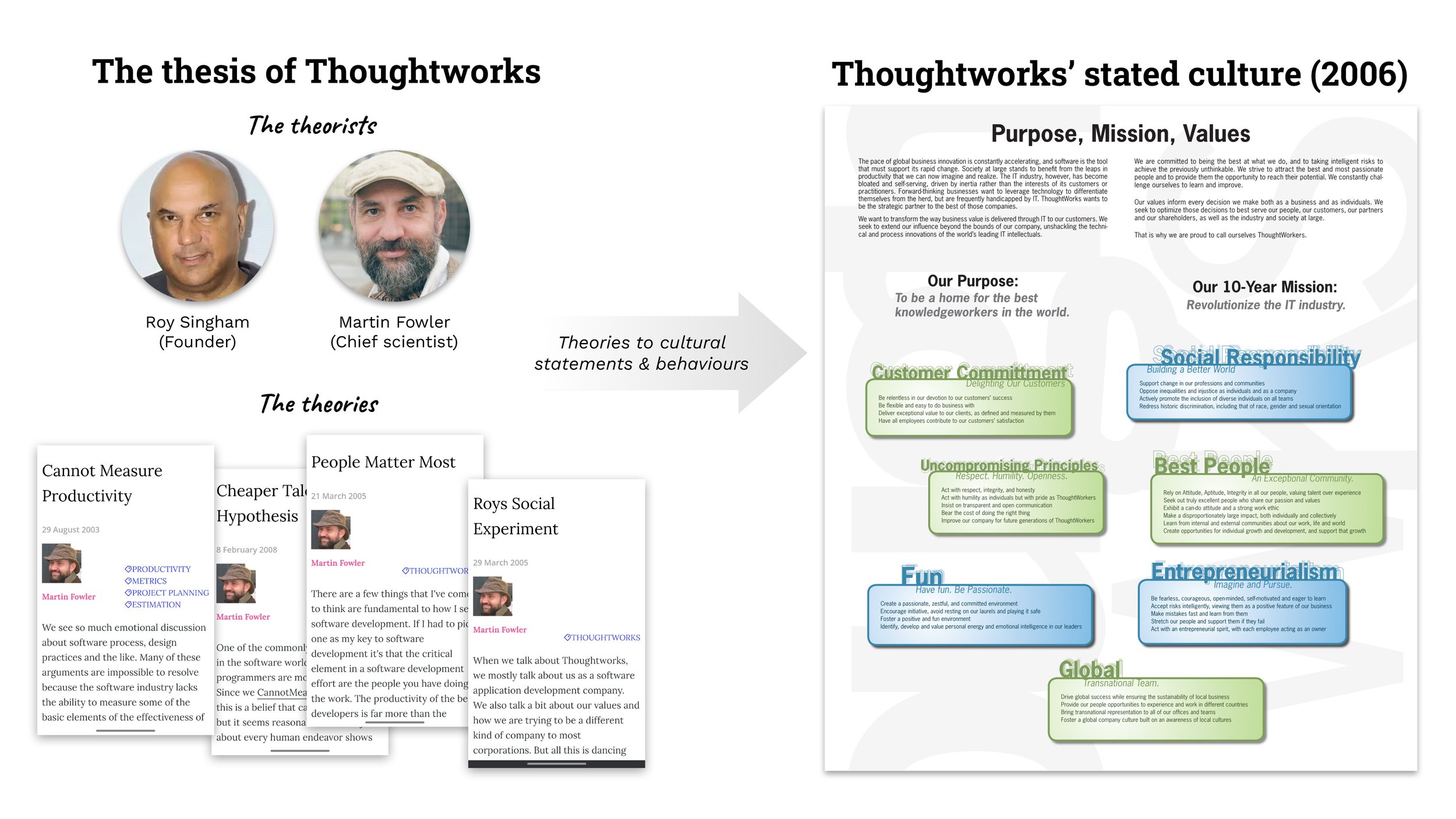
Thoughtworks’ strong theories led to credible brochures
When you examine those theories on Martin’s bliki, you’ll be able to explain why Thoughtworks behaved in a certain way at that time. The theory drove the practice.
You’ve seen this movie before
Look around, and you’ll find similar examples of strong theories driving aligned cultures. Here are a few examples:
37Signals’ founders have always written about their theories in texts like “Getting Real” and Rework, but the shortest primer about them is in their 37 signals! Since 37Signals is a small company, Jason and DHH, as founders, have an outsized influence on the culture and the ideas they continue to write about, shaping the company’s culture and behaviour.
Patagonia’s culture is grounded in Yvon Chouinard’s climbing background. In his book, Let My People Go Surfing, Yvon said that "the goal of climbing big, dangerous mountains should be to attain spiritual and personal growth.” He also outlined his product-first mindset; i.e. "the product comes first, and the company exists to create and support our products." The sustainability mindset that many of us love about Patagonia comes from Chouinard’s belief that “there’s no business to be done on a dead planet.” 1% for the planet is also Chouinard’s brainchild.
GitLab’s culture stems from a handbook-first theory. Their 2700+ page public handbook is an example of a transparent culture that aims to be WYSIWYG.
Ben Cohen and Jerry Greenfield influenced Thoughtworks’ culture, but not before they’d built an admirable company themselves. The duo pioneered the triple bottom line theory, balancing three interrelated parts – product quality, economic prosperity and social mission. Bernie Glassman influenced their theory by helping them envision businesses as vehicles for transforming communities. Glassman famously said, “We don’t hire people to bake brownies; we bake brownies to hire people."

A few compelling corporate theories
Of course, there’s no guarantee that a strong theory will lead to a lasting culture. Durability depends on many factors – business conditions, leadership, talent, and the company’s ability to adapt are a few that come to mind. But building an attractive culture without a strong theory is like building a skyscraper with no foundations. There’s no easy way around it.
Few of us will get to shape a company’s culture. That said, we can all become astute analysts of the cultures we move through. When a corporation tells its story, read it with x‑ray vision. Ask yourself which underlying theories could explain the company’s rituals, trade‑offs and decisions. If you notice a well‑documented, well‑understood theory, you’ll probably see a WYSIWYG company culture; if the behaviours don’t match the brochure, you’ll be able to explain why. One way or another, once you decode the theories beneath the values poster, you won’t look at corporate culture in quite the same way again.