
Trying a generative AI detox

Summary
To counter the addictive effect of LLMs, I’m embarking on a one-week generative AI detox. It’ll be an absolute ban on LLMs for personal use, and a nuanced ban at work. The aim is to reconnect with my craft, my judgment, and the pride I take in my work.
A few months back, I wrote about AI and the scarcity loop. LLMs can be quite addictive – they provide an alluring upside, unpredictable rewards and quick repeatability. It’s the perfect way for users to get hooked and stay hooked.
And then, just yesterday, I saw a video from Michael Paulson, a.k.a ThePrimeagen, commenting on Mo Bitar’s viral video, “I was a 10x engineer. Now I'm useless.” I’ll embed the video below, but here’s what Mo originally said about using generative AI,
“It's the best way to describe it is, it's a drug, and you can't wean off. Once you do it, you just want to do it all the time.”
Now, Mo Bitar claims to have experienced skill atrophy since he started using AI. Hence, he feels “useless”. In a different part of his Twitch stream, though, Michael disagrees with Mo. He believes that it's almost impossible to lose hard-earned skills, even if you don’t practice them. Michael does, however, acknowledge that you can lose the will to do cognitively demanding work. He uses a relatable example – many of us can’t watch a movie or a documentary at a stretch any more, because we’re now so conditioned to short-form content. By the way, there is evidence to say that frequent engagement with LLMs can induce skill decay.
I believe that in the near future, the greatest potential for AI automation lies in knowledge work that is acceptably risky, routine, and non-novel. Everything else will still need human judgment and ingenuity. I don’t believe in the pipe dreams of AGI.
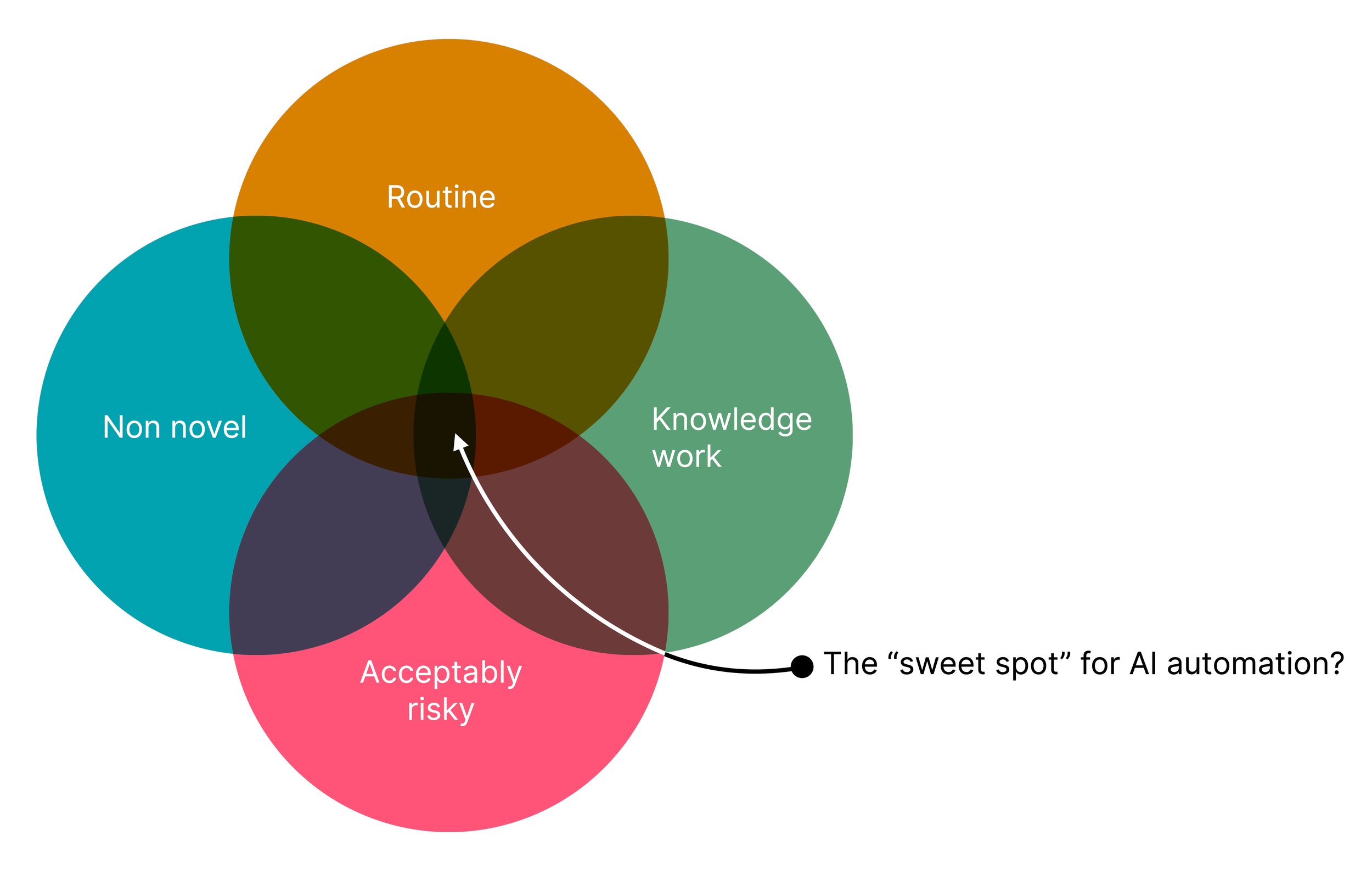
There are still only a few things that AI can wholly automate
And since I’m already invoking Michael, let me invoke him some more. There’s an argument that AI doesn’t reduce work; it intensifies it. Michael notes, quite rightly, that the performative button pushing to get LLMs to generate stuff makes us work more than we’d otherwise have. Of course it does. You can delegate only a few things to LLMs, so if mathy math is producing stuff at breakneck speed, and you’re responsible for what you ship, surely even overseeing the stochastic parrots stretches you to work more with every passing day. Since it’s addictive, we can’t break out. That addiction to AI makes us lazier and less connected to our work.
“My brain is less focused on a task. I feel less connected with what I'm building. I don't love it as much… My morning hand-coding time is the only thing that makes me feel sane, normal, and happy. And that's where I gain back myself.” - Michael Paulson.
In previous posts, I’ve noted that things aren’t going as fast as the media will have us believe. We can resist AI FOMO and jump on the train at a station of our choosing. Letting our skill and will atrophy is not worth it – not for us, not for our employers. Falling prey to addiction is never worth it. So I want to try a one-week generative AI detox and see how it affects me. How much will I miss LLMs if they weren’t a part of my toolset? What skill or will have I lost, due to my use of generative AI? What skills do I enjoy practising when I don’t have access to generative AI? How does a break from generative AI affect the intensity of my life and my mental health? Those are all questions I’d like to answer.
Let me describe what I have in mind.
I’m only going to avoid generative AI, not all AI. My camera, for example, has a built-in AI model that helps me focus on a subject's eye. I’ll continue to use AI assistance of that nature. The same goes for tools like DxO PureRAW, which help me denoise photographs.
I won’t use AI for search. Google enshittified search for cynical business reasons, and that led us to tools like Perplexity. I want to see if a regular search platform like Kagi, which incidentally uses Google’s search index, will help me be more critical about the sources I cite.
For all personal stuff, my detox will be absolute. No exceptions. But at work, I may find myself reaching for generative AI tools. Each time I do this, I’ll log my actions.
I’ll attempt to do the task by hand and ask myself if I really missed the AI tool, as a reflection.
If I find myself struggling with a task, without AI, I’ll attempt to embrace the struggle and do the hard thing. I’ll ask myself if the learning from the struggle was worth the pain.
If there’s no way to avoid using generative AI, I’ll use the tool and ask myself why LLMs are inescapable in the specific situation.
That’s it. Simple as. Who knows, I might report back on my experience next week and tell you how things go. Don’t hold your breath, though.
I will, however, encourage you to try your own version of an AI detox. See how it goes, and ask whether it makes you feel more connected to your work and skills. Ask if it helps you elevate your judgment and taste. You may discover that you’re addicted, as Michael is suggesting. If so, ask yourself how you’ll de-addict yourself. It could be a worthwhile exercise.