
Who needs a head of culture?

Summary
No company needs a “head of culture” until they need one. Enduring cultures need thoughtful design, so they can support several strategic iterations. In smaller companies that design can feel “organic”, if you have an invested set of leaders. The larger the company and the more changes it undergoes simultaneously, the greater the risk of cultural drift. Indeed, this is where formal roles, responsible for culture design, can be handy.
Dave Whalley, the former CIO of Thoughtworks, has had a huge influence on my career. When Dave says something, I listen. Recently, he wrote an interesting post on LinkedIn. I’ll copy it here verbatim.
I continue to see people with 'Culture' in their job title or role definition posting on Linkedin. If you are a leader in one of those companies who presumably thinks culture is a capability that can be outsourced to a single person or team, usually the 'People/HR' space, you need to give your head a wobble.
Culture is predominantly shaped and sustained by the behaviours of your leadership at all levels. Thinking anything else is asking for trouble. Even if you don't intend that person to be 'accountable' for culture, you are creating the impression of it. In any case, if it is part of a job title, then you surely are setting targets for said individual? Good luck with that.
Just no.
As is often the case, Dave has a fair point, and his point applies to me. I’m “head of culture” at Thoughtworks, after all. By the way, my beliefs align with Dave’s. Beyond a certain point, “head of culture” is a bullshit job, and it must shape-shift into other roles. But I must explain why such a role is sometimes a necessary, time-bound intervention rather than an attempt to outsource culture.
As a corollary to the statement above, you can’t assume that if someone doesn’t have "culture" in their job title, they don’t play an outsized role in shaping culture. If you look back in history, Thoughtworks is a prime example.
The myth of organic cultures
Companies like Thoughtworks, which we associate with a “strong culture”, often term their culture as “organic”. Surely, if a culture is “organic”, it needs no design. It flourishes by itself, doesn’t it? No, it doesn’t. Almost every admirable corporate culture (of which there are few) has someone who brings it to a point where it’s self-sustaining and self-preserving.
But before we get to culture-building and the validity of culture in job titles, let’s revisit what culture really is. I like Jason Fried’s definition the best.
“Culture is the byproduct of consistent behaviour. It's not what you say, it's what you do. Think of it as a fancy word for behaviour over time. It's the moving average of the last 50 days of what you've shipped, how you've treated each other, what you've said, what you've done.”
Most companies have brochures and posters that highlight their purpose, mission and values. When everyday behaviours are congruent with the brochureware, people experience a “strong culture”. Incongruence breeds distrust and often leads to a diluted culture.
Roy Singham, Thoughtworks’ founder, laid its cultural foundations. George Frederick Hegel was one of Roy’s inspirations, and he often hailed Hegel’s theory of the dialectic – there is no progress without conflict. Through the first 24 years of Thoughtworks’ existence, Roy shepherded the company through several such conflicts, where thesis and antithesis collided until Roy could facilitate a synthesis. He’d ensure that the company’s behaviours matched the cultural model he was after. We could get away without explicit culture design because Roy was around, and he was tireless.
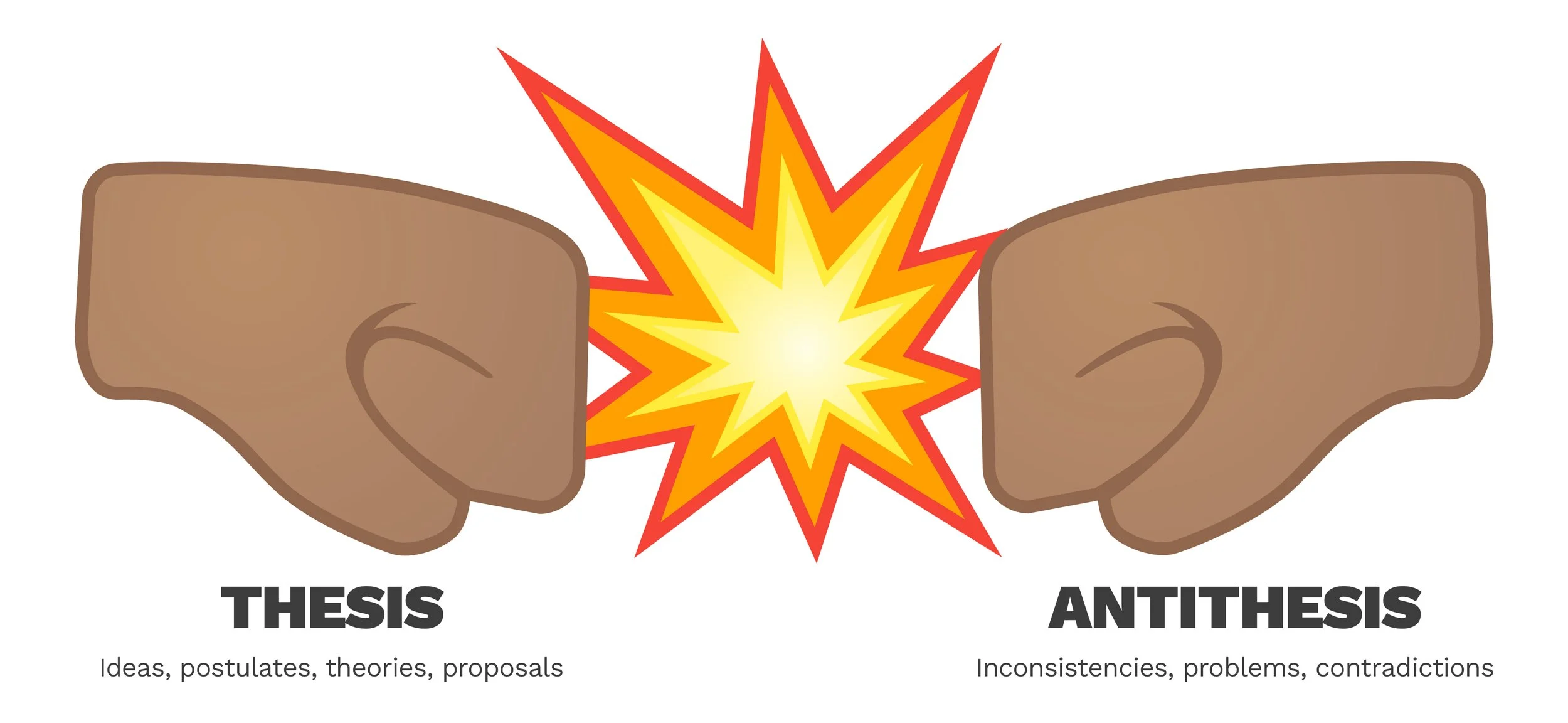
Synthesis often emerges from a conflict between thesis and antithesis. Such conflict is a desirable process for authentic culture design.
Culture-focused, without a job title
But even Roy knew that culture was far from being organic. There was a time when he could fly all around the world and talk to every employee, and maybe even debate them vigorously. By the time the company grew beyond the 500-person mark in 2004, Roy was flying 350,000 air miles each year. The company was scaling past even his “world-class ability to never stop talking”. As the legend has it, late that year, Roy deputed a project manager, Jeff Gray, to write a long-form document describing Thoughtworks culture. Jeff headed to Hilo, Hawaii, and produced an 80-odd-page manifesto that described “the history, aspirations and culture of Thoughtworks Inc.”
Did Jeff have a culture-focused role? Yes, for a spell of time, that’s exclusively what he did. But did it feature in his job title? No, it didn’t. Jeff eventually went on to become managing director of Thoughtworks North America, and in his bio, he said,
“My job is to set our vision, make sure our amazing people have the context and information to do great work, and ensure the chemistry experiment that is our culture keeps bubbling in interesting directions. If we do that right, we'll have a strong and growing company, a true platform for impact on our customers, our industry, and society.”
By the way, Roy never stopped playing his cultural role. In 2011/2012, Roy wanted to steer the company toward his activism. Through the force of his will, he rewrote the company's cultural framework and pivoted us to the three-pillar model. The previous articulation of Thoughtworks’ culture had seven values. This iteration had 11 cultural characteristics. I still can’t remember them all. I wasn’t a fan of the model to start with, but Roy was a persuasive creature, and the model grew on me.
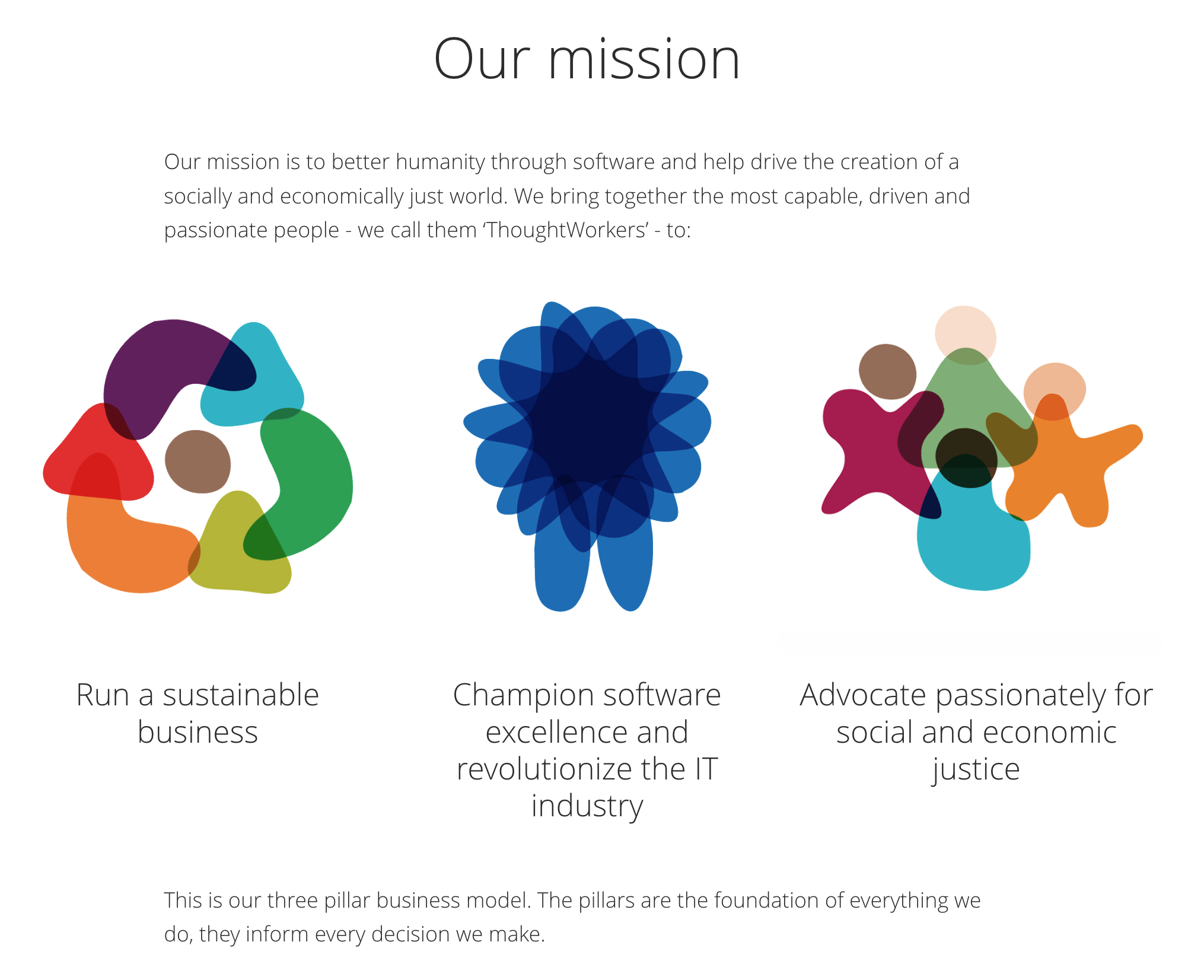
Thoughtworks' three pillar model represented its founder's force of will.
The peril of eschewing culture design
And then, in 2017, Roy sold the company and rode off to become a full-time activist. We believed we had a strong culture, and we didn’t realise how much of it relied on Roy’s ability to be the cultural glue. We never codified culture-aligned behaviours, but everyone trusted that while Roy was around, synthesis would emerge from conflicts. We never saw the risk that a loosely defined culture could also become a loosely practised culture.
At the time of sale, in August 2017, we were 4500 people. Today, we’re more than double the size. We went public in 2021 and are now privately owned again. We emerged through a pandemic, more distributed than ever.
We are not lone wolves anymore; we play well with partners. Our clients expect the world of us. Our leaders in 2026 are a rather different set from those in 2017.
In 2026, the company’s embarked on a bold, new, platform-powered strategy that changes how we engage with clients and the way we work.
But in the midst of all that breakneck change, we’ve not had the time to pause and reflect on how our company’s culture endures across generations and keeps pace with strategy. Indeed, culture eats strategy for breakfast, more so when inattention to culture makes it inhospitable to new strategies. We don’t want a situation where “cultural drift” sabotages our strategic agility.
A formal role with culture in the job title
That long-drawn context brings me to why I have my role. Thoughtworks has always believed that the right cultural model can jump business models. My role is to help shape that cultural model, but this time, as an act of conscious design. Any culture that stays in stasis risks decay. My job is to engage my 10,000+ colleagues in identifying what we should strengthen, stop doing, and start doing, so that our everyday behaviours support the next few strategic iterations of the company.
Pointy-haired processes that are incongruent with company values erode people’s faith in culture. So my job won’t end by just defining a cultural model. It’ll also be my job to engage with different parts of the business, so their processes also reflect the company’s values.
Indeed, this is where our chief people officer, John Reid-Dodick’s cultureOS framework comes in handy. It lists eight inputs to the culture one sees in practice – purpose, leadership, talent, agility, platforms, space, connection & citizenship. Between John and me, we see culture design as a conscious activity across those eight inputs.
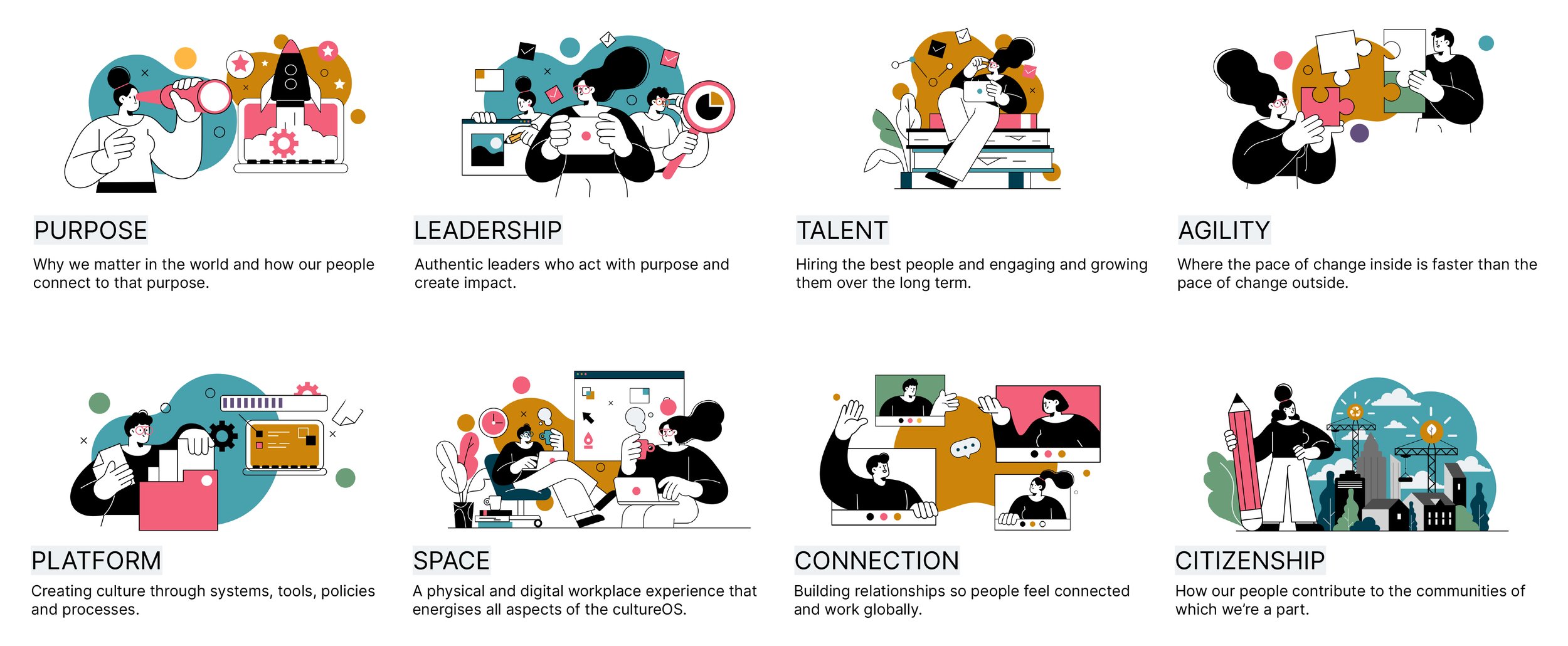
cultureOS — 8 inputs that shape corporate culture
Of course, as Dave says, my job title gives the impression that I’m “accountable” for culture. To some extent, I am. In a 10,000-person, fast-changing organisation spanning 18 countries, leaders are stretched to their cognitive limits. I can’t expect the company to design its culture serendipitously. And the longer the futile wait for that serendipity, the more we risk cultural drift. I’m here to mitigate that risk.
So, what qualifies me for a culture role?
Well, I’m one of the 100 most tenured people in the company. That makes me a human bridge between the past and the future. I’m also one of the little guys — not a founder, not an executive. I’ve been in the consulting trenches with my Thoughtworks mates. After close to two decades here, Thoughtworks is an indelible part of my life story. I’m invested in the company’s success. At the same time, I want my mates to thrive. Most importantly, I have a low tolerance for bullshit, much like Dave. I realise that, eventually, culture must be self-sustaining, and the greatest accountability rests with the company's leaders at all levels. But 10,000 employees far outnumber 400-odd leaders, and excluding them from the design process is asking for trouble.
I aim to facilitate the culture-shaping initiatives that get Thoughtworks to that self-sustaining state. There’s an act of Hegelian synthesis here as well – reconciling leadership vision with people’s expectations, and ensuring that everyone has a voice during the inevitable conflict that a cultural design process entails.
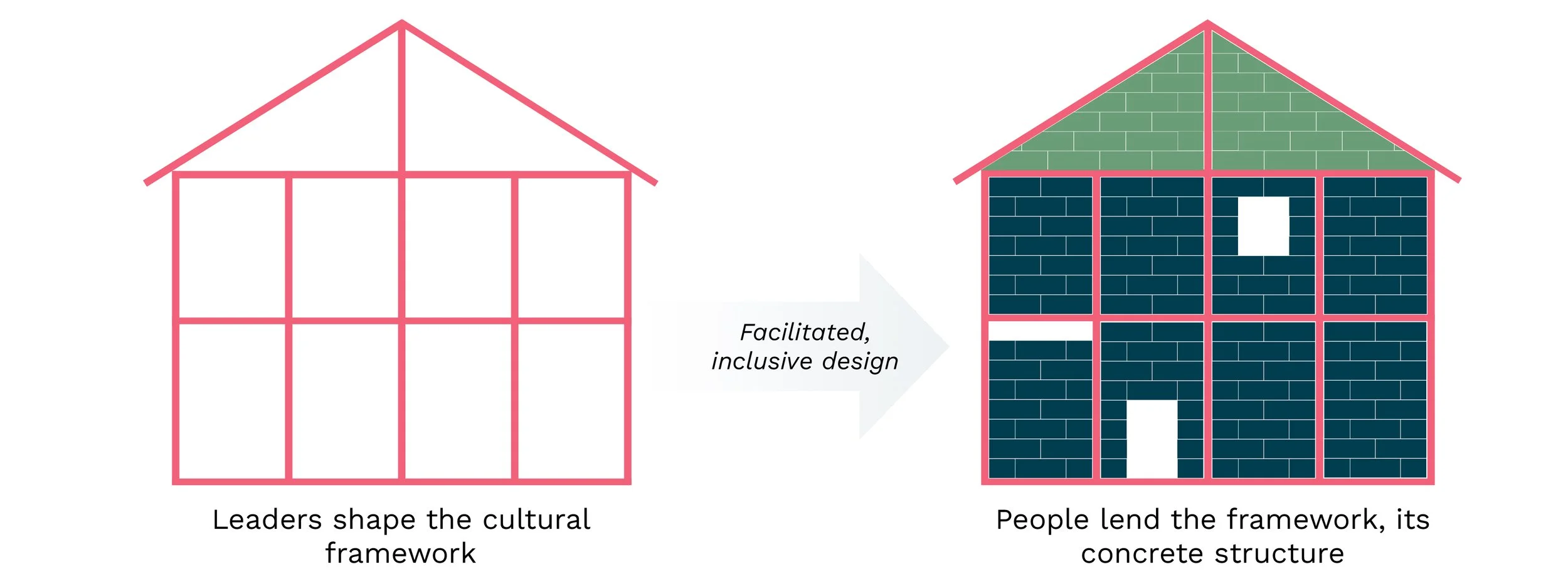
Facilitating cultural design
If this foundational design program becomes an empire of its own, I’ll consider it a failure on my part. Hold me to those words. In the meantime, though, I’ll wear my job title with some pride. If your organisation has someone with 'culture' in their title, don't assume they own culture – assume they're there to help you own it better.